
Day VFR Helicopter Operations From Trimbak–Nashik Helipad
Bativala M Bhagvati Flying Charters L.L.P. (BMBFCL) plans to operate Charter Helicopter Services between on regular basis for which Nasik/Trimbak Helipad, located at VITS Jayshin Resorts, Near Vaitarna Lake, Ghoti Trambak Road, Near Vaitarna Nagar, Zarwad Bk, Igatpuri, Nashik shall be used. The helipad has been offered to us by the owner to use the same for the Charter Operations.
The Operations from the Helipad will be carried out in close co-ordination with Nasik Road and Ozar Air Traffic Control and Mumbai FIC.
BMBFCL will undertake only Day VFR Operations from Trimbak-Nashik Helipad. PURPOSE AND SCOPE
- The Aim of this SOP is to lay down standard Operating procedures for safe and smooth conduct of Operations by Operators.
- SOP will additionally provide appropriate Operations Instruction to the Pilot to Operate from this helipad.
- It contains detail information regarding helipad site, security and safety facilities.
- The helipad Markings and Maintenance is to be done as per specifications of CAR Section 4, Series ‘B’ Part III.
This SOP also seeks to draw a viable coordinated contingency plan in the event of helicopter Incident/accident.
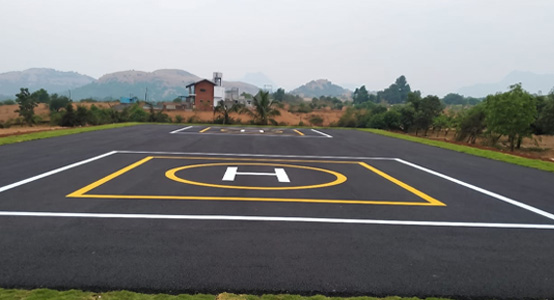
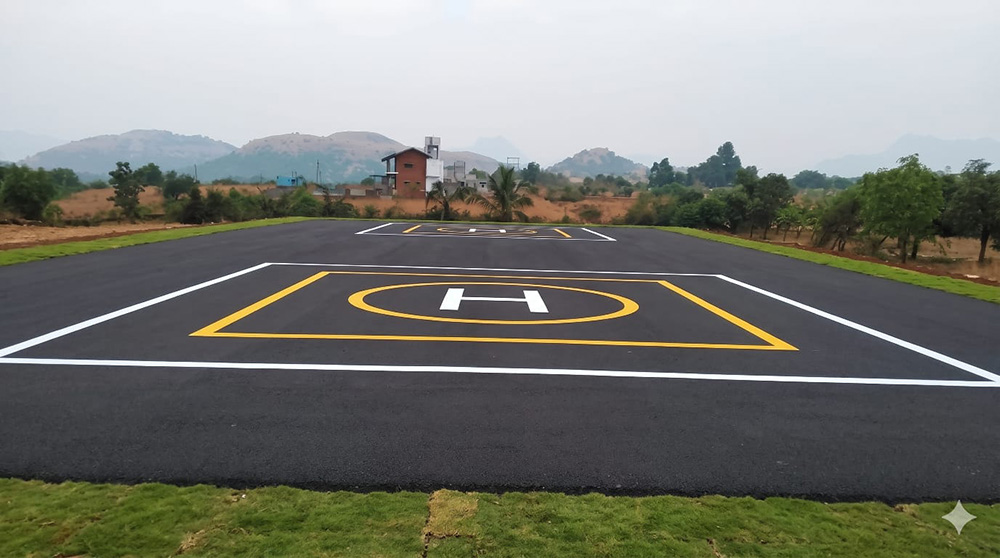
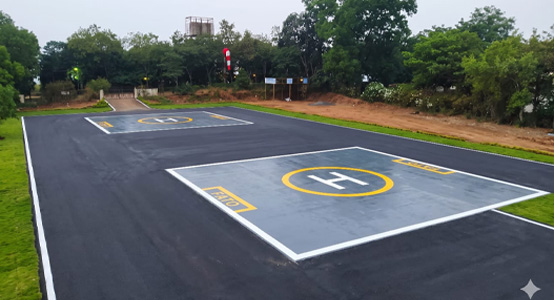
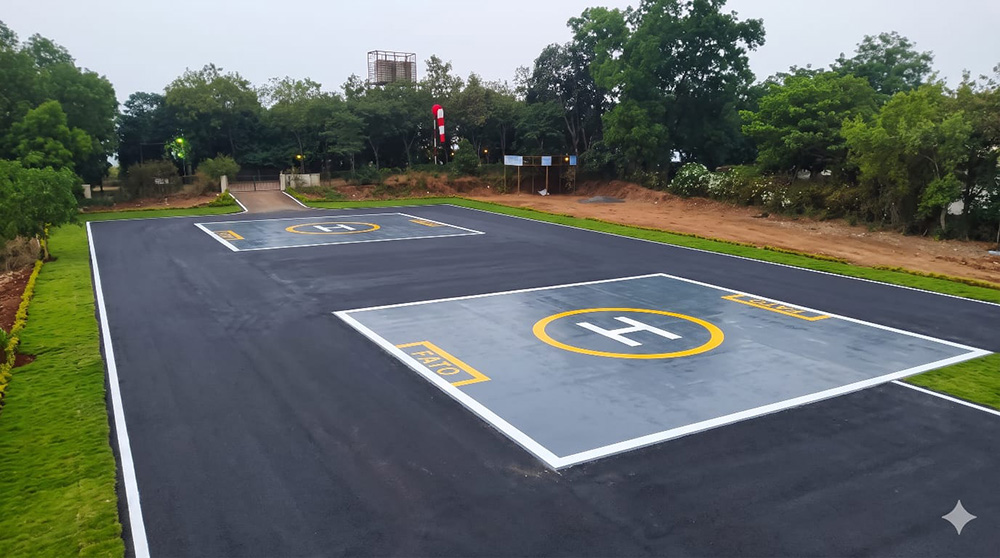
Helipad Location Map
Particulars of Helipad required to be reported to Aeronautical Information service (AIS)
| Sr no. | Information | Remark |
|---|---|---|
| 1 | Name of Helipad | Trimbak-Nashik Helipad |
| 2 | Location of Helipad | VITS Jayshin Resorts, Near Vaitarna Lake, Ghoti Trimbak Road, Near Vaitarna Nagar, Zarwad Bk, Igatpuri, Nashik, Maharashtra – 422214 |
| 3 | Coordinates of Helipad |
WGS 84 Pattern Latitude: 19°50’25” North Longitude: 073°30’23” East |
| 4 | Helipad Elevation | 2146 feet |
| 5 | Type of Helipad | Surface level Helipad (Square) |
| 6 | Name of Helipad Operator | M/s Bativala M Bhagvati Flying Charters L.L.P. |
| 7 | Purpose of Use | Non-Schedule Operations |
| 8 | Surface Type | Concrete |
| 9 | Load Bearing Capacity | W = 18 t |
| 10 | D Value | 12.70 meters |
| 11 | Safety Area | Minimum 3 Mtr (Calculated 0.25 D) Marked 04 Mtr |
| 12 | Required Helipad Diameter | TLOF (0.83D) + FATO (0.83 D) + Safety Area (0.25 D) (10.5+10.5+4=25) 25 Mtr |
| 13 | Wind Direction | In accordance with Wind Rose Diagram obtained from Met Dept. the prevailing winds are generally Easterly & Westerly in this part |
| 14 | Visual Aid | One Wind Sock (As per CAR 4B III) is clearly visible from approach path dimension as length: 1.2m. Larger end 0.3m shorter end 0.15 m with minimum alternated being first and last band of darker colour, preferably orange-white combination |
| 15 | Approach Funnel | Helipad has Approach/Takeoff funnel aligned to East (110°+/-10°) and West (290° +/-10°) both funnels have divergence of 10° and are 180° apart |
| 16 | Nearest Aerodrome | Ozar Airport is Located 28 NM towards North East on Bearing of 054° |
Layout
The layout consists of one Concrete helipad with total concrete surface of 60 mtrs x 60 mtrs.The helipad is secured with wired fence on all sides with only one exit entry gate guarded bysecurity 24x7. Fire Points are marked, Helipad has passenger Lounge with separate screening facility for male & female passenger.
Circuit Pattern
Wind direction: - As per the Wind Rose diagram obtained from Meteorological Department. The prevailing winds are generally Easterly/westerly in this part. Thus, it gives a preference for an East / West approach for the helicopter operation. Keeping in view the wind direction and the presence of obstacle around, it is recommended to have an approach/ Take Off funnel of 110° / 290°
Helicopter operating at Trimbak-Nashik helipad will follow a Westerly (Race Course) Circuit Pattern. Prevailing winds being predominantly Easterly & Westerly in this part, the Take-off direction for helicopter will essentially be 110° or 290° and landing direction will be 290° or 110°, depending upon wind conditions. The circuit height will be 500 ft AGL. Routing In/Out will be in coordination with of ATC Ozar. All VADs and VARs in the vicinity will be avoided.
Radio Frequency/Communication
All helicopters operating to/from Shirdi helipad will maintain positive RT contact with Ozar ATC. Important Radio Frequency are: -
| Ozar Approach | 120.600 Mhz |
| Ozar Radar | 120.600 Mhz |
| Ozar Tower | 122.700 Mhz/123.500 Mhz |
| Nasik Road | 119.700 Mhz |
| Mumbai Radar | 127.900 Mhz |
Safety and Fire Fighting Services:
- Safety Services in form of firefighting services, first aid Kit will be maintained serviceable at all times. Base Manager will ensure that the ambulance is available as per MOU.
- Fire extinguisher as per H-1, category and approved type will be readily available at
both the helipads as per CAR Section 4, Series B Part III, Table 6-1 and 6-2 asunder: -
Category Water(L) Discharge Rate Foam Solution(L/Min) Dry Chemical Powders (Kg) Halons(Kg) Co2 H1 500 250 23 23 45 Either one of these - NO SMOKING board must be displayed at all locations.
- Personnel connected with operations have been adequately trained.
Medical Facilities
- A Ground FIRST AID KIT is located at helipad to meet any emergency.
- Pre-Flight Medical for the flight crew shall be done by the Doctor before undertaking the first flight of the day.
- The telephone numbers of Doctor and Hospital is given in Appendix-
Fuelling:
- It shall be carried out in accordance with procedure and Standards laid out in CAR Section 2. Airworthiness Series ‘H’ Part II and Part III for Barrel Refueling.
- Fuel will be filled in Barrels from authorized Dispensing Agencies (HP Aviation / IOC Aviation). It will be carted in Trucks.
- A max of 5 barrels (1000 Ltrs) at a time will be stored at Fuel room which is 100 Mtrs away from center of helipad.
- Fuel after having been checked for water contamination will be dispensed into the tank of the helicopter
- Adequate No Smoking Signs will be displayed in the fuelling Zone.
- No refueling will be carried out with passengers on board / in the fuelling area/zone.
- All other fuel barrels will be stored at a safe distance in a securedarea.
- All barrels in storage will be lying on their sides with their bungs in three ‘O’clock or nine ‘O’ clock position.
Conduct of Flying Operation
Co-Ordination / Preflight Actions
Pilot in command of the helicopter shall take following actions:
- Ensure that preflight medical is done, load & trim calculation done and Nav plan is prepared.
- Calculate fuel requirement based on sortie duration, weather conditions, diversions available and minimum reserve fuel to be carried as given out in the CAR.
- Ascertain maximum number of passengers that could be carried for Landing /Take off as per FM based on fuel carried, prevailing temperature and elevation of helipads.
- Crew members and passengers are made familiar, by means of an oral briefing or
by other means, with the location and the use of:
- Seatbelts.
- Location of First Aid Kit.
- Passenger emergency briefing cards.
- Switching off mobile telephones.
- Operations Department of respective operators will be overall responsible to coordinate all movements of helicopters to/from Nasik/Trimbak Helipad with Ozar ATC and Mumbai FIC in accordance with clearances. A proper Air Defense Clearance (ADC) & Flight Information Centre (FIC) number will be obtained for each flight planned
- All movements will be communicated to Ozar ATC & positive clearance will be obtained before undertaking any flying. Prefight medical of the aircrew will be conducted and record maintained.
Payload Calculations
The payload calculations will be done in accordance with the Flight Manual by the pilot depending on the OAT and helipad elevation. The load and trim sheet requirements shall be fulfilled prior to take off. Trim sheet shall be completed by PIC.
Maximum Operating Temperature
Helipad is Apprx. 2000 Ft AMSL, Asper will be max operating temperature.
Passenger Manifest
- The operations/commercial staff of BMBFCL before boarding must prepare manifest of all passengers in two copies. One copy of the Manifest will be handed over to PIC.
- PIC must ensure that weight of passengers and baggage must be kept in limits so as to not exceed max AUW. Actual weight of the passenger will be considered for calculation. Weighing Scale with proper calibration is available at helipad.
Passenger Baggage
- No heavy / bulky baggage of passengers shall be carried.
- Passenger Baggage to be carried in baggage hold compartment only.
Embarking of Passengers
- All passengers will board under the supervision of BMBFCL’s trained ground staff.
- They will be briefed about the emergency exit procedure, embarking, and disembarking.
- The Ground crew will strap them.
Procedure Applicable To Certain Category Of Passenger:
Handling of Passengers with reduced mobility and children will be done with utmost care.
Crew Qualifications Requirements
Single Pilot operations will be carried out with pilots having minimum experience as defined in CAR Section 8, Series H, Part II.
Operational Structure And Team For The Activity
The Base will be deployed as follows:
- Station Manager - BMBFCL Asst Operations Manager (will be overall in-charge of safety of helicopter operations, passenger and ground staff safety)
- Base Asst Ops -1
- Security – 4
Flight Safety
The Following aspects of flight Safety are pertinent:
- All aspects of flight safety shall be strictly adhered to as laid down in the Air Safety circulars and CAR issued by DGCA from time to time.
- Helipad should have been marked as per the existing procedure.
- Except for the take-off and landing phase, helicopter shall maintain a height not less than 100 ft above obstructions.
- Regular internal Audit of Helipad will be done by Chief of Flight Safety of BMBFCL.
Security Policy
- Security Helipad will be sanitized as per BCAS regulations, helipad is fenced from all side with only one exit/entry gate guarded by helipad Security 24*7
- Baggage and passengers will be frisked manually and by Metal detectors. ASPL also plans to install X-ray machine for baggage scan in future
- In case any security threat is suspected, the procedure as defined by the BMBFCL approved Airline Security Programme and local police will be applied.
Coordination With Rescue Coordination Centere
In India, the Flight Information Centre act as Rescue Coordination Centers, in addition to their other functions. When an aircraft is reported or when it is known to have forced landed. The RCC will immediately take action to notify all those who could usefully assist in the SAR operations and will coordinate their actions. The Contact details of the Rescue Coordination Centre- Mumbai is given below; it must be contacted by PIC immediately after forced landing.
Rescue Coordination Centre - Mumbai Rcc
- Name: Rescue Coordination Centre – Mumbai
- Postal Address: Airports Authority of India, C.S.I. Airport, Mumbai 400099
- Telephone: +91-22-26819421(RCC), EPBAX +91-22-26828100 Extn 3421, +91- 2226828002/8022(OCC/FIC), +91-2226828088(WSO)
- Fax: +91-22-26828121(RCC), +91-2226819341(OCC/FIC), +912226828066(WSO)
- AFS: VABBYCYX
- Telegraphic: Air Com
- SAR Area: Mumbai FIR
- Responsible agency or department: Flight Information Centre, Mumbai
Contingency Plan: Search Andrescue
- It is of utmost importance to have a well-coordinated contingency plan, which can be put into action in case of an accident.
- List of Important telephone numbers of local authorities is available as Appendix -B
- In case a May Day call is made then the Chief of Operation of operator must be able to follow a planned set of actions to render assistance to the concerned helicopter as soon as possible.
- The details of the Contingency plan, Quick Reaction Emergency Team, Crash
Scenarios, Search and Rescue Service is included in Appendix- A (i to iv)which are
listed as under
- Formation of Quick Reaction Emergency Team.
- Helicopter Overdue Action.
- Accident in vicinity of Ozar
- Search and Rescue flowchart.
Conclusion
- All personnel of ASPL engaged in this operation shall be properly briefed on conditions and procedures laid down in this SOP.
- All personnel must strictly adhere to the laid down procedures.
- All personnel work in close tandem in order to achieve the following goals in order of
priority.
- Safe operation
- Passenger service and satisfaction with world class service
- Attention must be given to third party for noise abetment.
The change in procedure will be immediately informed to DGCA.